
In 1890 William McKinley, as chairmen of the House Ways and Means Committee, passed through Congress the McKinley Tariff. The Democrats used the high tariff against the Republicans in the 1892 election, claiming high tariffs created higher prices. After the Democrats won the nation fell into a recession and the voters began to believe the … Continue reading Class Notes
Author: James Finck
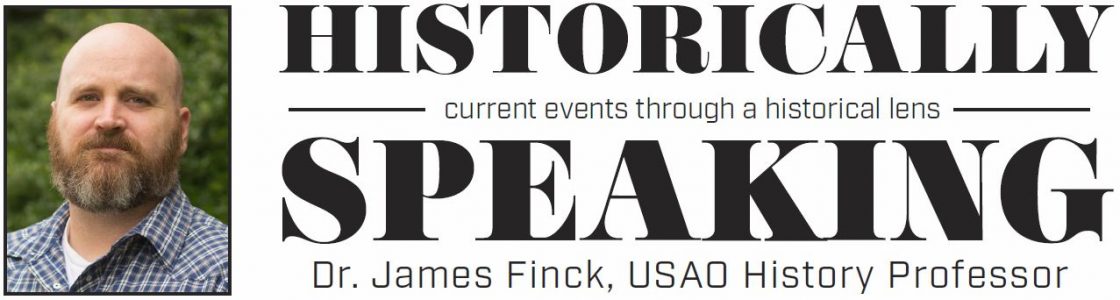
Dr. James W. Finck was raised in the shadows of history in the great state of Virginia. Growing up it was difficult to travel too far without running into a monument or battlefield from the Revolutionary or Civil War. In this environment, Finck developed a love for studying the past and from his youth knew that he wanted to make it his life’s work. Finck received a B.A. from the College of William and Mary in Virginia. He then studied under James I. Robertson and William C. Davis at Virginia Tech, while earning a Master’s degree. Finally, he received his Ph.D. at the University of Arkansas, under the direction of Daniel Sutherland. For five years, Finck taught at the University of Texas-Pan American before accepting his current position as American Historian at the University of Science and Arts of Oklahoma in 2011. At a small liberal arts institution, Finck considers himself a generalist in history, but his specialties are the Civil War and American Politics. Finck has established himself in Oklahoma with the creation of the Oklahoma Civil War Symposium, which has brought in leading Civil War scholars for the past eight years, and he has spoken at many venues around Oklahoma, especially working with the Honey Spring Battlefield. Finck is the author of Divided Loyalties: Kentucky’s Struggle for Armed Neutrality in the Civil War, as well as Images of America: Chickasha. Finck is also the author of the syndicated newspaper column “Historically Speaking.”
Class Notes
The issues with the Stamp Act for the colonists were first that it was a new tax that they had not paid before. However, the larger issue was that the tax was now being collected by Parliament, instead of their colonial legislatures. In the past they were only taxed locally, so they not only elected … Continue reading Class Notes
Class Notes
After the French and Indian War, the British had 10,000 soldiers still left in the colonies. Now that Pontiac’s Rebellion was over, and the colonists were forbidden to go west of the Appalachian Mountains, there was no need for the troops in the west. Instead, they were stationed in eastern cities. The British were always … Continue reading Class Notes
Class Notes
One of the most interesting things about the 1892 Election is the repeating of history. One of the biggest issues for the Republican Party was ballot integrity. They were mostly concerned that their biggest constituency in the South, the Black vote, was being denied suffrage. They knew they had no chance to win in any … Continue reading Class Notes
Religion In Government
I am inspired this week by an assignment my wife is doing for a Law in Education class. Her assignment was to write about religion in school and particularly release time for religious classes. It is an interesting assignment for her because, unlike most of her class, she grew up in a state that actually … Continue reading Religion In Government
Class Notes
The 100 plus years that England had allowed the colonists to function somewhat independently came to an end with the French and Indian War. The British looked around after the War ended and noticed that the colonists had not been following the rules established for colonies. The problem was that during these 100 years the … Continue reading Class Notes
Class Notes
The Beginning of the French and Indian War did not go so well for the British fighting in the Americas. The British Army greatly outnumbered the French Army, so there was no incentive for the French to fight in a traditional European style. Instead, they used guerrilla tactics and attacked small settlements. When they did … Continue reading Class Notes
Class Notes
The Election of 1892 is one of the least exciting and least talked about elections in American history. The Democrats ran a lawyer who had a proven track record of reform, welcome back ex-President Grover Cleveland. The Republicans also ran a lawyer with a proven track record on reform, current President Benjamin Harrison. Neither one … Continue reading Class Notes
Class Notes
When Charles II was brought back to his father’s throne after the Civil War, he did all he could to work with Parliament, after all his father had lost his head. Mainly he tried to be a good Anglican. One problem was since he did not have any heirs the next in line for King … Continue reading Class Notes
Class Notes
Another thing to take into account when studying the American Revolution is the political situation in England that had a direct influence on the colonists. At the time of colonization, nations in Europe, like Spain, France, and England were in the process of transitioning from feudal kingdoms to the centralized ones. The difference was that … Continue reading Class Notes

