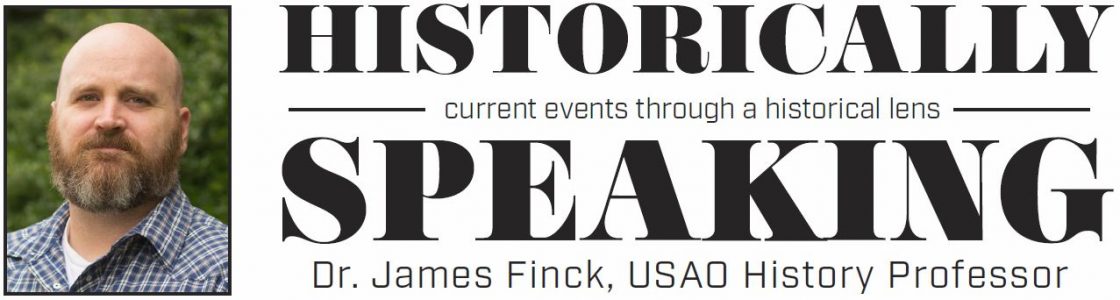

You may have heard me say this before, but I consider myself one of the lucky ones. I have the dream job I have always wanted, and I love going to work every day and talking about the importance of American history. Yet this semester there have been some changes that, honestly, have taken away some of my joy. The university has financial circumstances that need fixing. There is no question about that. But some of the things that have made the university my dream job have begun to change.
When I serve on hiring committees, the two things I use to sell the college are the quality of our students and the freedom to teach any class. I normally teach a combination of survey classes and electives such as Political Parties, Constitutional Law, and, most importantly, the Civil War. Being at a small college, I have had to make myself a generalist. But when my rotation comes back around to the Civil War, I remember why I chose it as my concentration. It has always been my first love.
Some of that has changed this year. This academic year, I am basically just teaching survey classes. Going an entire year without teaching an upper-level specialty history class is hard. It is not simply because those are the most interesting classes to teach; it is because, at a time when American history seems to be under attack, we need these classes more than ever. So many of my students believe America is simply an oppressor and do not understand just how special this nation and its Constitution are. I sometimes wonder whether it is a coincidence that we seem to be moving closer to another civil war at the same time we are spending less time teaching about the last one.
I know I am a dinosaur. The world changes, colleges change, and the needs of students change. I understand that. But understanding why things change does not necessarily make it easier to accept losing something you love. And with all these changes, it has become harder to find the same joy in my job that I once took for granted.
With all this on my mind, my in-laws offered to give my son their old car, which meant I had the opportunity this past week to fly out to Virginia and drive it back to Oklahoma. The timing could not have been better. I needed a few days of quiet contemplation to consider my future. Instead of making the drive in the usual day and a half, I decided to take a full three days. I wanted time to think, to meditate, and perhaps to reboot myself by remembering why I fell in love with history in the first place.
For Civil War historians, Virginia is the mother church. More battles were fought there than in any other state. And for those of us who study the war, the landscape itself often feels like a sacred text. Growing up in Virginia, I was surrounded by the war. Its battlefields, its monuments, and its stories were never far away. I felt connected to it in a way that is difficult to explain to someone who has never lived among those places.
I needed that connection again. I needed to commune with the church that is Virginia. I needed to put my feet on the ground where so many Americans had fought bravely and sacrificed their lives. There is something different about standing on sacred ground. Reading about a battle can teach you what happened, but walking across the land where it happened reminds you that the people who fought there were real.
Before leaving, I had made a plan to stop at a couple of places along the way home. It is an easy drive, one I have made many times before. Interstate 66 to Interstate 81 south, then Interstate 40 west all the way to Oklahoma.
But as I left Haymarket, Virginia, I found myself doing something different. Instead of turning onto Interstate 66, I found myself drawn to Route 29. The road runs south through Virginia’s Piedmont, in the foothills of the Blue Ridge Mountains. It is a landscape rich in history. Both Union and Confederate troops marched and fought along this road.
I quickly abandoned my original plans and decided to do something I have always wanted to do. I would simply wander. I realized that if I truly wanted to reconnect with the things I loved, I needed to get off the interstates and make my way home along the back roads. I had no idea where I was going or what I would see. I decided to let the road tell me. My only rule was that I had to be back in time for class Monday morning.
I had my perfect playlist, “A River Runs Through It” on audiobook, some of the most beautiful scenery and fall foliage in the nation, and three days to rediscover my love of history or maybe myself.
I made my way south through Virginia, driving through several battlefields along the way, until I realized that I had never been to Danville. At the end of the Civil War, Danville briefly served as the Confederate capital for eight days.
My only regret was that I did not realize my route would take me practically through Liberty University. Had I known, I would have made plans to have lunch with one of the best historians I know. Next time, Michael.
When I was ready to leave Danville, I knew I needed to start heading west. But rather than turn north toward the interstate, I realized I could head south through North Carolina and make my way through Asheville.
My favorite elementary teacher always called North Carolina “God’s country,” so I decided to drop south and head for Ashville. The scenery was breathtaking. The mountains rose around me, the trees were turning colors, and the roads wound through a landscape that seemed designed to make a person slow down and look around. North Carolina has some of the best people, great history, and, I think, the best barbecue. But I must apologize to any Tar Heel readers when I say that I now also believe North Carolina has the worst drivers. Wandering is not about going fast, but I do not think I went the speed limit once the entire time I was in the state.
Leaving North Carolina, I crossed Tennessee, traveling mostly along Highway 70, the state’s oldest roads. I passed through numerous historical sites, but I spent most of my time at the Battle of Franklin.
From there, I continued west, passing through Mississippi and Arkansas before finally making my way into Oklahoma. I traveled from the wooded hollows of eastern Tennessee along the Cumberland Mountains, past the Mississippi Delta and its thousands of acres of cotton fields ready for harvest, and finally through southeastern Oklahoma until I reached Chickasha late Sunday night.
Somewhere along the way, I realized the trip had given me exactly what I needed. I still do not know what will happen at the school or what classes I will be able to teach in the future. I cannot control that. But walking the grounds of battlefields, breathing the air of places I had studied for years, talking about history to people at small roadside diners reminded me why I love what I do.
Perhaps that was the lesson I needed most. I had spent so much time thinking about what was changing at the university that I had begun to lose sight of what had not changed in me. I still love history. I still believe in the importance of teaching it. And I still believed that America is something worth understanding and preserving.
Maybe it was because I was driving through the South, but I was also reminded that America is still strong. If more people could turn off the news and wander along the back roads, they would discover that many Americans still love their country. In every state I passed through, I saw countless American flags flying outside homes.
I was especially impressed by a little town in Tennessee called Rockwood. Before I even entered the town, I noticed that the streetlights had banners hanging from them. The banners were part of something called Hometown Heroes, and each one displayed a photograph of a member of the community who had served in the military. They continued all the way through town and beyond.
As I listened to “A River Runs Through It,” I was inspired by a passage that suggests we might become better fishermen if we spent less time watching and waiting for the conditions to become perfect. There is wisdom in that thought that reaches well beyond fishing. We can spend only so much time stressing over the circumstances to improve. We need to jump in and fish.
I cannot guarantee that I will teach another Civil War or Constitutional Law class next semester, or even next year. I can only do what is within my power. For now, that means teaching my survey classes and doing my best to help my students understand the history of the greatest country in the world.
Maybe that is enough for now.
This is an independent story and not connected with the Lawton Constitution.

